
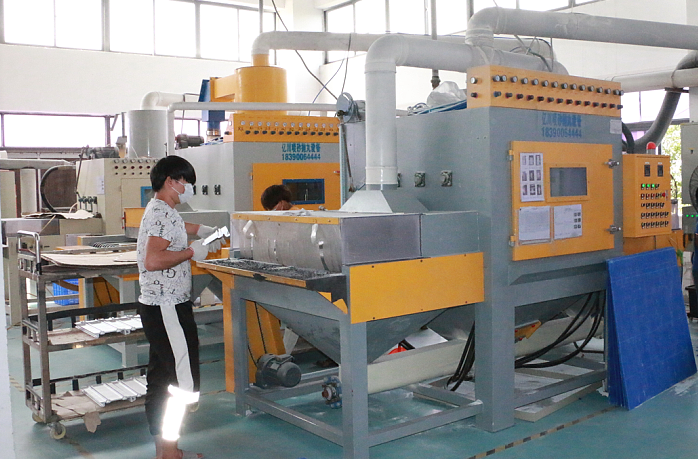
The short answer: the changes that reduced our emissions and waste most were also the changes that reduced our cost per litre of saleable coating. We treat sustainability as a yield and energy problem before we treat it as a reporting problem. A plant that wastes less material, evaporates less solvent and rejects fewer batches is both cheaper to run and easier to describe honestly.
Guangdong Hanze New Material Technology manufactures high-temperature ceramic coatings, PTFE dispersions and related products. Coating manufacture is a chemistry business with a physical footprint: solvents that evaporate, energy that heats ovens, water that rinses equipment, and material that ends up as waste when a batch is off-specification or a container cannot be fully emptied.
This article describes what we changed, what it cost, what it returned, and where the limits of a plant-level claim sit. It is written for the buyer whose own sustainability reporting has started to ask questions about upstream suppliers, and for the engineer who wants to know whether a supplier's claims are about substance or about presentation.
In this article
- Why we treat sustainability as a cost problem first
- Water-based conversion: what it actually saves
- Solvent handling and recovery
- Energy: where a coating plant actually spends it
- Waste reduction at the source rather than the bin
- What we measure and what we deliberately do not
- What it cost us and where the return came from
- The limits of a plant-level claim
- What this means for a customer
- FAQ
Why we treat sustainability as a cost problem first
There is a version of environmental improvement that is purely a reporting exercise: choose metrics that look good, publish them, and change nothing on the plant floor. There is another version that starts from the physical flows and asks where material, energy and water are being lost. The second version is slower to write up and considerably more durable.
We took the second version for a practical reason. A coating plant is a margin business, and the largest controllable costs are raw material, energy and yield. Any change that reduces solvent evaporation, oven energy or reject rate shows up in the cost of goods. Framing the work that way meant it survived the first quarter, because it was justified by the accounts and not only by the policy.
| Physical flow | Where it is lost | Whether it is also a cost |
|---|---|---|
| Solvent | Evaporation in mixing, application and drying | Yes, directly — material bought and not sold |
| Energy | Oven and drying zones, mixing motors, compressed air | Yes, directly |
| Water | Rinsing between products and equipment cleaning | Yes, in treatment and heating |
| Raw material | Off-spec batches, residue in containers, spillage | Yes, directly |
| Packaging | Drums that cannot be reconditioned | Yes, in purchase and disposal |
| Rejected product | Material made and not sold | Yes, the largest single loss |
Water-based conversion: what it actually saves
Moving a product from a solvent-borne to a water-based formulation removes most of the organic solvent from the material itself. That is the headline saving, and it is real. What is often missed is that it changes the plant as well: the ventilation load in the mixing hall falls, the drying section has to grow, and the cleaning regime changes because water-based residue behaves differently from solvent residue.
We do not claim that water-based is universally better. A water-based line uses more energy in drying than an equivalent solvent line, because water has a higher heat of vaporisation and a higher surface tension, and it is harder to remove from a film. The net environmental benefit depends on how the electricity is generated and how efficiently the drying section is designed. We state the trade-off rather than presenting the conversion as unambiguously positive.
| Aspect | Solvent-borne | Water-based | Net direction |
|---|---|---|---|
| Volatile organic content | High | Low | Strong improvement |
| Drying energy per part | Lower | Higher | Worse unless the drying section is efficient |
| Fire and explosion risk | Higher | Lower | Strong improvement |
| Cleaning regime | Solvent-based | Water-based, different residue behaviour | Neutral to better |
| Effluent load | Low volume, high treatment need | Higher volume, lower hazard | Depends on the treatment plant |
| Application tolerance | Forgiving of humidity | Sensitive to humidity | Worse without humidity control |
Solvent handling and recovery
Where a solvent-borne product remains the correct technical choice, the priority is to prevent the solvent from reaching the atmosphere and to recover what can be recovered. We improved this in three places: closed mixing rather than open, capture at the point of use rather than general ventilation, and segregation of solvent waste streams so that clean streams can be recovered rather than incinerated.
Why segregation matters more than capture
A mixed solvent waste stream is nearly worthless: it must be disposed of, usually by incineration, and the energy in it is lost. A segregated stream of a single solvent can be recovered and reused, which avoids the cost of buying fresh material and the emissions of producing it. The labour cost of segregation is small, and the return is immediate, which made this the easiest change in the programme.
| Measure | Before | After | Why it mattered |
|---|---|---|---|
| Mixing vessel closure | Open vessels in a ventilated hall | Closed vessels with local extraction | Reduced evaporation at the source |
| Point-of-use capture | General ventilation only | Local capture where solvent is handled | Concentrated the stream and cut losses |
| Waste segregation | Single mixed solvent waste | Separated by solvent type | Enabled recovery instead of disposal |
| Container management | Partial-empty drums returned | Drained and reconditioned where possible | Reduced residual material loss |
| Spill response | Reactive cleanup | Defined procedure and containment | Cut incidents and their cost |
Energy: where a coating plant actually spends it
The dominant energy consumer in a coating plant is not the office or the lighting; it is thermal. Ovens and drying zones run continuously and their losses are structural rather than behavioural. That is why the largest energy reductions came from insulation, zoning and recuperation rather than from switching lights to LEDs.
Recuperation is the single most effective measure we implemented. Exhaust air from a curing oven carries usable heat, and a heat exchanger that transfers some of it to incoming air reduces the fuel or electricity needed to raise that air to temperature. The payback is measurable and it does not change the product.
| Energy measure | What it addresses | Result |
|---|---|---|
| Oven insulation upgrade | Structural heat loss from oven walls | Lower standing loss, especially on idle |
| Zone control | Whole-oven heating when only part is loaded | Heat applied where parts actually are |
| Exhaust heat recuperation | Heat leaving in exhaust air | Pre-heated incoming air, lower fuel use |
| Compressed air leak survey | Continuous loss from the air system | Lower compressor load at no product risk |
| Variable speed on mixing motors | Motors running at full speed regardless of load | Energy matched to the actual mixing demand |
| Drying section airflow tuning | Over-ventilation of the drying zone | Less air heated than necessary |
Why airflow tuning is worth more than it sounds
A drying zone that moves more air than it needs heats more air than it needs. Airflow is often set high to solve a drying problem that is actually a film-build or humidity problem, and once set it is rarely revisited. Measuring the actual drying requirement and reducing airflow to meet it lowered energy use without changing the dried film, because the film only ever needed the air it needed.
Waste reduction at the source rather than the bin
Waste falls into two categories, and they call for different responses. Process waste is material lost inside the process: residues, spills, cleaning losses. Product waste is material that was made and not sold: off-specification batches and rejects. Product waste is the larger loss and the more damaging one, so reducing it is both an environmental and a commercial priority.
Most of our product waste reduction came from the quality programme rather than from a waste programme. Better batch control, in-line monitoring and hold points meant fewer batches failed after they had consumed raw material and energy. A batch caught during mixing costs the raw material; the same batch caught at filling costs the raw material, the energy and the packaging.
| Waste type | Main source | Primary control |
|---|---|---|
| Residue in containers | Incomplete emptying | Draining procedure and container design |
| Cleaning losses | Changeover between products | Sequencing and minimal-volume cleaning |
| Spillage | Transfer and filling operations | Containment and closed transfer |
| Off-spec batch | Formulation or mixing deviation | In-line control and hold points |
| Rejected filled product | Fault found after packaging | Earlier release testing |
| Expired retained stock | Shelf life exceeded | Demand-driven batch sizing |
What we measure and what we deliberately do not
We measure the physical quantities that correspond to real flows: solvent purchased and evaporated, energy consumed per tonne of saleable product, water used and treated, and waste mass by category. We do not publish a headline percentage reduction without stating the baseline and the boundary, because a percentage without those two facts is not a measurement.
There is a second discipline here. Our boundary is the manufacturing site. We do not claim a reduction in the environmental impact of a customer's application process, because we do not control it, and we do not claim a figure that includes raw material extraction we have not audited. We state what happens inside our fence line, which is what we can see.
| Metric | Why we track it | How it can mislead |
|---|---|---|
| Energy per tonne of saleable product | Links energy use to output, not to activity | Falls if output mix shifts to easier products |
| Solvent purchased and used | Directly tied to losses | Misses changes in solvent type |
| Water used and treated | Drives effluent load | Depends on treatment efficiency, not volume alone |
| Waste mass by category | Shows where loss concentrates | Hides toxicity differences between streams |
| Reject rate | Largest single material loss | Can be gamed by redefining a reject |
| Batch yield | Day-to-day control measure | Affected by small batch sizes |
What it cost us and where the return came from
We are specific about cost because a sustainability section that omits it is usually a marketing section. The programme required capital for extraction and containment, insulation and heat recovery, and instrumentation; it required downtime for installation; and it required time to write the procedures and train the team. Not all of the measures paid back on the same timescale.
The fastest returns came from the measures with no product risk: leak surveys, airflow tuning, waste segregation and container draining. The slower returns came from the capital items, where the payback depends on energy prices and utilisation. The least quantifiable benefit was also the most useful commercially: customers asking about upstream practice found a supplier with a concrete answer rather than a statement of intent.
| Measure | Capital or labour | Return type | Payback character |
|---|---|---|---|
| Compressed air leak survey | Labour | Energy | Immediate |
| Drying airflow tuning | Labour and instrumentation | Energy | Short |
| Waste stream segregation | Labour and containers | Material recovery | Short |
| Container draining procedure | Labour | Material recovery | Short |
| Extraction and containment | Capital | Solvent recovery, safety | Medium |
| Oven insulation and recuperation | Capital | Energy | Longer, depends on utilisation |
| In-line batch monitoring | Capital | Yield | Longer, but largest total |
The limits of a plant-level claim
A manufacturer can be honest about its own operations and still leave the largest part of the impact unaddressed, because the largest part usually sits in the customer's application and in the service life of the coated product. A coating that lasts twice as long halves the impact of coating it twice. That is where the biggest reduction potential lies, and it is not something we can claim as a plant metric.
This is why our position is that the most useful environmental contribution we make is a coating that performs as specified for as long as possible, produced with the least waste we can manage. Durability is an environmental property. A coating that fails early is an environmental cost as well as a commercial one.
What we do not claim
We do not claim carbon neutrality, because we have not purchased offsets and we do not consider an offset purchase to be a reduction. We do not claim that our water-based products are automatically lower impact than solvent-based alternatives in every application, because the comparison depends on the drying energy and the electricity source. And we do not publish a reduction figure without the baseline and the boundary attached to it.
| Common claim | What it usually hides | Question to ask |
|---|---|---|
| Carbon neutral site | Purchased offsets rather than reduced emissions | How much was reduced, and how much was offset? |
| X percent lower emissions | The baseline and the boundary are unstated | Against which year, and within which scope? |
| Eco-friendly coating | Undefined; may refer only to the carrier | Which property, measured how? |
| Zero VOC | Depends on the definition of VOC used | Which regulatory definition and which method? |
| Recyclable packaging | Technically recyclable may not mean collected | Is it reconditioned in practice in my region? |
What this means for a customer
Three things are practically useful to a buyer. First, we can state the composition of a product and whether it is water-based or solvent-borne, and we can supply the documentation your reporting requires. Second, changes we make to our process do not change your product, and where a change could affect it we tell you before it ships. Third, where durability is the main environmental lever in your application, we will help you specify for life rather than for initial cost.
| Your requirement | What we can provide | What we cannot provide |
|---|---|---|
| Composition documentation | Formulation and carrier declaration | Certification we have not obtained |
| Upstream emissions data | Site energy and waste data | Audited cradle-to-grave figures |
| Lower-impact material option | Water-based systems where technically suitable | A universal lower-impact recommendation |
| Durability for life-cycle benefit | Specification support and test data | A guarantee of service life in your process |
| Change notification | Advance notice of process changes | Notification of changes that do not apply |
FAQ
Is a water-based coating always the lower-impact choice?
No. Water-based formulations remove most volatile organic content, which is a real and large improvement in air emissions and fire risk. They also need more drying energy, because water is harder to remove than solvent. Whether the net impact is lower depends on how your electricity is generated and how efficiently your drying section is designed. We will give you the trade-off rather than a slogan.
Can you supply data for my scope 3 reporting?
We can supply site-level energy, water and waste data for the products you buy, and composition documentation for the material itself. We cannot supply audited cradle-to-grave figures including upstream raw material extraction, because we have not audited those supply chains. We will tell you exactly what the boundary of our data is.
Do you purchase carbon offsets?
No. Our position is that a reduction achieved on site and an offset purchase are different things, and we report only the former. If your reporting framework accepts offsets separately, that is a decision for your organisation and we will not blur the distinction on our side.
How does coating durability relate to environmental impact?
It is often the largest single factor. A coating that lasts twice as long halves the material, energy and emissions associated with coating the part twice. That is why we treat lifespan and performance consistency as environmental properties, not only as quality properties.
Will a process change on your side affect the coating I buy?
The process changes described here sit around the product rather than inside it, and the formulations are unchanged. Where a change could affect the material you receive, we notify affected customers before the change ships. If you need documentation of any change for your own records, ask and we will provide it.
How the batch gets released
Fewer rejects is both a cost saving and the largest single reduction in material waste. See how a batch is verified before it ships.
Where capacity and waste meet
The same process discipline that raised output reduced rejects. See what changed on the water-based line.
Explore the range
Our metal cleaning products support the pre-treatment stage where much of the water and waste burden sits.